Diaphragm Wall Equipment helps contractors build deep, reinforced concrete barriers in crowded urban sites, transport corridors, and below-ground structures. The work is demanding. A stable trench, reliable slurry circulation, and accurate panel alignment all matter. Small equipment choices can affect the entire sequence.
Geotechnical engineer Ralph B. Peck is often credited with the observation, “The most important single factor in the design of a structure is the nature of the ground on which it is to be built.” That principle applies to equipment selection, too. Ground conditions, required wall depth, panel dimensions, and site access shape the choice between grab systems and hydromills. Buyers also need to examine cutter control, slurry plants, lifting capacity, spare-part access, and local service support. Specifications on paper are useful, but field support can be decisive.
This guide introduces ten manufacturers active in the worldwide market. It compares their equipment ranges and practical considerations, rather than treating any ranking as universal. Product availability and service coverage can change by region. A machine that suits one project may be poorly matched to another. That is worth remembering. The strongest choice is usually the one that fits the ground, project method, and contractor’s operating experience—not simply the most powerful model.
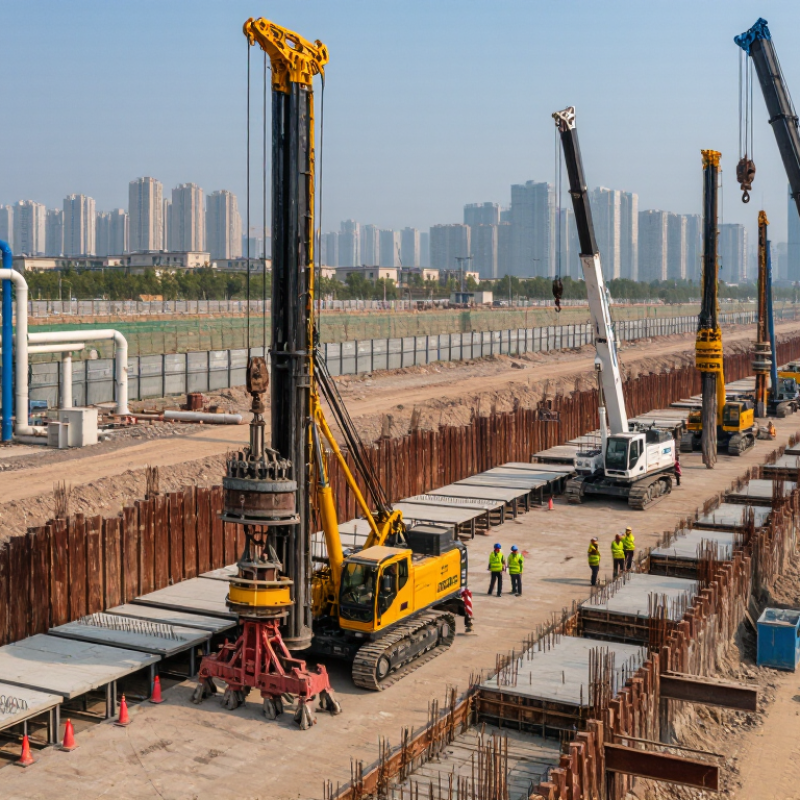
Diaphragm wall equipment creates deep, continuous support walls where space is tight and excavation loads are high. A hydraulic grab removes soil in rectangular panels, often in layered ground. A cutter, sometimes called a hydromill, handles deeper or harder formations and can deliver more consistent panel alignment. Ground conditions decide. Neither method suits every site.
Support equipment matters just as much. Slurry mixing and recycling plants keep bentonite or polymer fluid within workable limits, while desanders remove soil particles before reuse. Crawler cranes lower grabs, cutters, and reinforcement cages. Tremie pipes place concrete from the panel base upward, displacing the slurry. Watch the slurry carefully. Poor control can affect wall cleanliness and concrete quality.
These systems serve underground parking structures, metro stations, utility shafts, ports, and flood-protection works. In dense city sites, panels may sit close to existing foundations, so positioning accuracy and vibration control are practical concerns. Equipment selection depends on wall depth, soil profile, groundwater, access, and required tolerances. A tidy specification can still mislead; actual ground often changes during excavation. Allowing room for maintenance and spoil handling can prevent avoidable delays.
Diaphragm wall equipment is designed around the ground it must cut and support. Engineers review soil investigations, groundwater levels, wall depth, and panel dimensions before selecting a cutting system. A grab may suit some ground conditions, while a hydromill can offer more controlled excavation in others. Neither choice works everywhere.
The machine’s frame, hydraulic system, cables, and tools must handle substantial loads while keeping the excavation aligned. Designers also consider slurry circulation, spoil removal, access around the site, and the space needed to assemble equipment. Small details matter. A poorly placed hose or awkward service panel can slow routine maintenance.
Manufacturing begins with fabricated steel components, carefully prepared joints, and dimensional checks. Critical welds are inspected, and hydraulic circuits are tested for leaks and stable operation. Assembly teams verify that cutting tools, guides, and controls work together before equipment reaches a project site. Fit is never automatic. Even detailed calculations can miss practical issues, such as difficult transport routes or limited crane access. Feedback from operators helps refine later designs, though no machine can remove every site-specific challenge.
Choosing diaphragm wall equipment requires more than comparing quoted prices. A rig may look powerful on paper, yet struggle in dense soil, restricted headroom, or a narrow urban site. Evaluate its working range: cutting depth, panel dimensions, verticality control, and compatibility with the planned grab or cutter. Ask for field records from ground conditions similar to yours. Numbers without context are weak evidence.
Reliability shows up in details. Inspect hydraulic hoses, wear parts, access panels, and the time needed for routine service. Ask how quickly critical components can be supplied, and whether technicians can support commissioning and operator training. Downtime is expensive. A capable machine can still be a poor choice if maintenance depends on distant specialists. This is easy to overlook.
Safety and control systems deserve equal attention. Review alarms, emergency stops, operator visibility, and procedures for lifting and repositioning equipment. Request operating manuals, inspection schedules, and documented test results instead of relying on broad claims. Then compare lifecycle costs, including fuel, consumables, transport, and expected repairs. The cheapest offer may not stay cheap. Even a careful shortlist leaves uncertainty; a site demonstration can reveal awkward controls or uneven performance that brochures cannot show. That extra check is worth planning.
A worldwide comparison of the top 10 diaphragm wall equipment manufacturers is most useful when it looks beyond machine size. Buyers should examine cutter stability, hydraulic control, slurry handling, and the manufacturer’s ability to support equipment far from its home market. A machine may look impressive on paper. Yet performance depends on ground conditions, operator skill, and maintenance access.
For a practical assessment, compare maximum excavation depth, wall thickness range, and cutting accuracy. Ask how the system handles changing soil layers, such as dense gravel above softer clay. Check whether wear parts can be replaced on site, and whether technical staff can diagnose faults quickly. Downtime can be costly. Reliable service matters.
The strongest manufacturers tend to offer more than a base machine: they provide commissioning guidance, operator training, and clear maintenance schedules. Still, no single specification proves that a system suits every project. Not every project. A procurement team should review verified project records, request comparable references, and inspect service arrangements in the intended region. I would also allow room for uncertainty: published output figures may reflect ideal ground, not a crowded urban site with restricted access and variable geology.
Company names and brands are intentionally omitted. The rows below describe ten equipment categories commonly used in diaphragm wall construction; they are not a ranked list of manufacturers.
| No. | Equipment Category | Primary Function | Typical Project Parameter | Common Selection Consideration |
|---|---|---|---|---|
| 1 | Hydraulic diaphragm wall grab | Excavates soil in rectangular panels while the trench is supported by slurry. | Common wall thicknesses include approximately 600–1,500 mm; grab dimensions must match the specified panel thickness. | Soil conditions, panel geometry, required verticality, and available lifting capacity. |
| 2 | Mechanical cable-hung grab | Excavates panels using a clamshell grab suspended from a crane. | Suitable configurations depend on the required trench depth, grab weight, and crane capacity. | Crane reach and capacity, ground conditions, excavation accuracy, and site access. |
| 3 | Hydraulic trench cutter | Uses counter-rotating cutting wheels to excavate and mix soil at depth. | Used for deep panels and hard or variable ground; achievable depth and panel dimensions are model- and ground-dependent. | Rock strength, required wall depth, slurry circulation, and verticality monitoring. |
| 4 | Guide wall formwork and guide wall system | Forms a shallow surface guide that positions the excavation and supports the trench entrance. | Guide wall layout is designed around the specified panel thickness and construction sequence. | Survey accuracy, surface stability, reinforcement clearance, and site layout. |
| 5 | Bentonite slurry mixing plant | Mixes water and bentonite to prepare support slurry for trench excavation. | Plant capacity is selected to match excavation rate, slurry storage, and project demand. | Mixing output, storage volume, water supply, and slurry quality-control requirements. |
| 6 | Slurry desander and treatment plant | Removes excavated soil particles from slurry so it can be reused where project specifications permit. | Processing capacity is matched to excavation output and the required slurry-cleaning rate. | Separation efficiency, screen configuration, recycling capacity, and disposal arrangements. |
| 7 | Slurry storage and circulation system | Stores and circulates support fluid between the trench and the treatment plant. | Storage and pumping capacity depend on trench dimensions, excavation sequence, and site logistics. | Pump flow, tank arrangement, pipeline routing, and spill-control measures. |
| 8 | Reinforcement cage lifting system | Lifts and places prefabricated reinforcement cages into completed panels. | Lifting plans are based on cage length, mass, lifting points, and crane configuration. | Crane capacity, cage stability, rigging design, and coordination with concrete placement. |
| 9 | Concrete tremie system | Places concrete from the bottom of a slurry-filled panel to displace the support fluid upward. | Tremie pipe diameter, length, and number of pipes are determined by panel geometry and the placement plan. | Continuous concrete supply, embedment control, pipe joints, and quality records. |
| 10 | Panel-joint and stop-end system | Forms and controls joints between adjacent diaphragm wall panels. | Joint configuration is selected to suit wall thickness, waterproofing requirements, and construction sequence. | Joint alignment, water-resistance requirements, extraction method, and compatibility with the excavation method. |
Technical dimensions and capacities vary by project, ground conditions, equipment configuration, and local specifications. Confirm final values against project documents and equipment technical data.
Comparing diaphragm wall equipment manufacturers requires more than counting models or comparing headline specifications.
A useful review examines grab systems, trench cutters, slurry circulation units, desanding plants, and supporting cranes. Look closely at achievable trench depth, wall thickness, soil compatibility, and how quickly equipment can be moved between sites. Small details matter.
Technology comparisons should focus on measurable jobsite needs.
Sensor systems can track verticality and excavation depth, while automated controls may help operators maintain consistent cutting performance. Ask how calibration works and what maintenance the system requires. Sophisticated software is not automatically better; crews need clear readings they can trust, even in noisy, muddy conditions. That distinction is easy to overlook.
Global reach also means more than shipping equipment overseas.
Check regional service coverage, spare-part availability, operator training, and response times for technical support. A machine may perform well in a demonstration, yet downtime can change the economics of a project. Compare documented specifications with references from similar ground conditions, and request details about local support. No ranking is perfect: project geology, crew experience, and site access can outweigh small differences between manufacturers. A careful comparison should state those limits rather than imply one universal winner.
As electricity costs continue rising, many small households in Maharashtra seek sustainabl...Read More
Uttar Pradesh is making significant progress in adopting renewable energy, particularly so...Read More
With the Indian government actively promoting renewable energy through subsidies and polic...Read More
Tired of watching your electricity bills climb month after month and strain your pockets? ...Read More
Switching to solar energy in Gujarat has never been more profitable! With plenty of sunlig...Read More
If you live in Madhya Pradesh and want to save money on power while living a greener lifes...Read More
If you’re a resident of Bangalore looking to save on your skyrocketing electricity b...Read More
If you live in Karnataka and have been looking for an environmentally friendly, cost-effec...Read More
Delhi is a city that thrives on its vibrant energy, and what better way to complement that...Read More
As electricity costs continue rising, many small households in Maharashtra seek ...Read More
Uttar Pradesh is making significant progress in adopting renewable energy, parti...Read More
With the Indian government actively promoting renewable energy through subsidies...Read More