What Are the Best China Residential Solar Panels?
Choosing the best China residential solar panels requires more than comparing headline wattage. Roof direction, seasonal shade, heat, humidity, and installer quality can change real performance. A 430-watt panel may look impressive on a showroom wall, yet perform poorly beneath a water tank or nearby tree. The roof decides.
China remains the world’s largest photovoltaic market. The International Energy Agency Photovoltaic Power Systems Programme reported rapid global capacity growth in its Trends in Photovoltaic Applications 2024 report. China’s National Energy Administration also reported more than 600 GW of cumulative solar capacity by the end of 2023. Distributed systems formed a significant share of that total, showing strong demand for smaller installations. However, national figures do not prove that every residential product is suitable for every home.
This guide evaluates residential solar panels through measurable criteria: module efficiency, temperature coefficient, degradation rate, warranty coverage, certification, and local service. IEC 61215 and IEC 61730 remain important benchmarks for module reliability and safety. Independent assessments from organizations such as PVEL and TÜV Rheinland can add useful evidence, especially for heat, damp-heat, and mechanical-load performance. Real installation experience matters too. A panel’s datasheet cannot reveal careless cabling or weak roof mounting.
No panel wins every roof. That is the uncomfortable part.
Some manufacturers publish limited long-term field data, while marketing language can sound stronger than the evidence. Buyers should compare complete system costs, not panel prices alone. This article examines leading Chinese brands with that caution in mind, separating laboratory claims from practical household value.
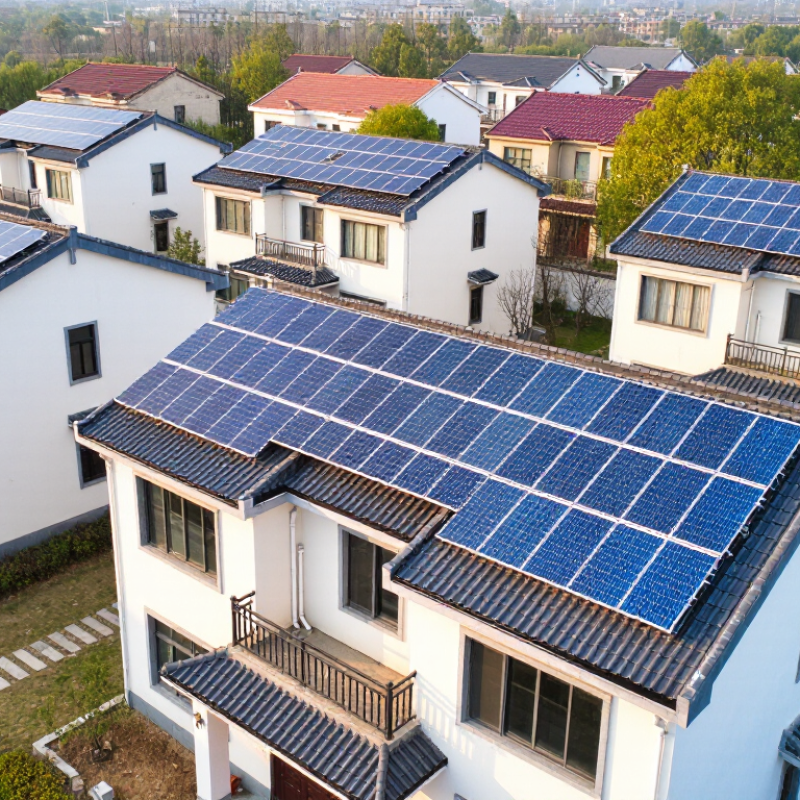
What Defines a High-Quality Residential Solar Panel in China
A high-quality residential solar panel from China should be judged by measured reliability, not appearance or peak wattage. The IEA PVPS Trends in Photovoltaic Applications 2024 report recorded 216.9 GW of new solar capacity in China during 2023. This scale supports strong manufacturing experience, but volume alone cannot prove panel quality.
Start with certified performance. Look for IEC 61215 and IEC 61730 testing, plus clear factory traceability. A suitable panel should show low annual degradation, a stable temperature coefficient, and reliable performance in humid or hot conditions. The 2024 PV Module Reliability Scorecard highlights thermal cycling, damp heat, and mechanical stress as important failure tests. These tests resemble real roof problems, including heat expansion, moisture, and heavy wind.
Details matter.
For a typical home, a panel with 21% to 23% efficiency can reduce roof space pressure. A lower temperature coefficient may also protect output during a hot summer afternoon. Check the product’s power tolerance, junction-box protection, glass strength, and warranty terms. Installation experience matters too. Poor cable routing or weak roof mounting can damage an otherwise excellent module.
Some specifications remain easy to overvalue. A higher wattage rating may come from a larger panel, not better efficiency. Laboratory degradation results may not predict every coastal or dusty rooftop. Buyers should request independent test data, production-batch records, and local installation references. That extra verification takes time, but it exposes the difference between a polished datasheet and dependable residential equipment.
Leading Types of China-Made Solar Panels for Home Use
China-made residential solar panels now cover several leading technologies for home use. Monocrystalline panels remain the practical default because they produce strong output from limited roof space. Their dark, uniform surfaces suit many modern homes. TOPCon panels usually offer improved efficiency and lower degradation than standard PERC designs. They can perform well during hot summers, though installation quality still matters. Heterojunction panels combine crystalline silicon with thin layers, often delivering excellent temperature performance. They may cost more. Polycrystalline panels remain a budget option, but their lower efficiency requires more roof area.
From site comparisons, roof direction, shade, and ventilation often matter more than small efficiency differences. A panel facing partial afternoon shade may underperform despite impressive laboratory figures. Check IEC 61215 and IEC 61730 certification, tested fire ratings, mechanical-load data, and the product’s temperature coefficient. Review degradation terms carefully. A long warranty sounds reassuring, but its claim process and local support deserve equal attention. I would not choose from efficiency alone. That shortcut can become expensive.
Tips:
Measure usable roof space before comparing prices. Request an hourly shade assessment, not a casual visual check. Compare usable energy, not only wattage. Ask for serial-number tracking and written installation records. Confirm the inverter matches the panel voltage and household load. Leave ventilation gaps beneath the panels. A cooler panel usually performs better. Inspectors may also require specific mounting and grounding methods. Recheck local rules before ordering.
How to Compare Panel Efficiency, Durability, and Warranty Terms
When comparing China-made residential solar panels, efficiency is only the starting point.
Fraunhofer ISE’s Photovoltaics Report 2024 places leading commercial crystalline-silicon modules near 22–24% efficiency. Many residential panels remain closer to 20–23%. A two-point difference can matter on a small roof, especially with chimneys or afternoon shade.
Efficiency matters. Check the temperature coefficient too.
A panel rated at 22% may produce less during a hot summer afternoon. In practical roof assessments, usable annual energy matters more than the largest laboratory number.
Durability requires evidence beyond glossy specifications.
IEA PVPS Task 13 reports that field degradation varies widely, while many studies fall near 0.3–0.8% per year. NREL’s PV Lifetime Project also highlights moisture, heat, and connectors as recurring failure factors.
Look for IEC 61215 and IEC 61730 qualification, but remember that these tests are not lifetime guarantees.
Read the exclusions. Product warranties may cover defects for 12–25 years, while performance warranties often extend 25–30 years. Check the promised output in year 25, the allowed annual decline, labor coverage, shipping duties, and warranty transfer rules.
A long warranty with difficult claims is weak protection.
One uncomfortable point: lower-priced panels can be sensible, but only when installer quality and local service are reliable. My comparison would record every clause, not just the headline percentage.
China’s Major Residential Solar Panel Manufacturers and Product Strengths
China’s major residential solar panel manufacturers compete through efficiency, durability, and flexible design. Many large producers now offer modules above 22% efficiency, helping households generate more power from limited roofs. Their strengths often include advanced cell structures, half-cut layouts, and multi-busbar wiring. These features can reduce energy loss when part of a panel is shaded.
Roof space matters.
Some manufacturers focus on lightweight panels for older buildings. Others produce larger glass-glass modules for homes facing strong wind, snow, or coastal humidity. In my experience, reinforced frames and reliable drainage details can matter more than a small efficiency difference. A panel that performs well in laboratory testing may behave differently under dust, heat, and uneven installation.
Quality control separates strong suppliers from average ones. Established Chinese factories commonly use automated inspection, electroluminescence testing, and tighter power tolerances. They may also provide product warranties lasting 12 to 25 years, though warranty conditions deserve careful reading. Installation records, local certification, and service response are equally important. A low price can hide slower support.
I would not select panels by efficiency alone. Temperature coefficient, mechanical load ratings, degradation data, and inverter compatibility need comparison. Some newer designs look impressive, but long-term field evidence remains limited. That uncertainty should be discussed honestly with installers and homeowners.
How to Choose the Right China Residential Solar Panel for Your Home
Choosing a China residential solar panel starts with your roof, not the product catalogue. Measure usable roof area, shading, pitch, and structural capacity. A panel with higher efficiency can help on a small roof. Fraunhofer ISE reported commercial module efficiencies commonly reaching about 20% to 23% in 2024. However, efficiency alone is not enough. Check the temperature coefficient, low-light performance, mechanical-load rating, and documented power tolerance.
Reliability needs evidence. The IEA PVPS Trends 2024 report recorded about 216.9 GW of new solar capacity in China during 2023, showing enormous manufacturing scale. Scale does not guarantee quality. Request independent test reports, IEC certification, serial-number traceability, and a clear warranty from the seller. Review the warranty’s remaining output, repair process, and exclusions. A long warranty is weak if nobody can enforce it locally.
Match the panel with the inverter, battery, roof direction, and local electrical rules. NREL research commonly uses roughly 0.5% annual module degradation as a planning assumption, but real results vary with heat, humidity, installation, and maintenance. Ask for the panel’s degradation curve, not only its first-year rating. A sensible installer should inspect cable routing and drainage before quoting. I would also compare delivered cost, not just panel price. Cheap shipping can become expensive after taxes, replacement delays, or unsuitable connectors. My first choice might still be wrong if the roof assessment is rushed.
What Are the Best China Residential Solar Panels?
Typical module efficiency by solar-cell technology for residential applications
N-type TOPCon and HJT panels generally provide the highest residential module efficiency, making them suitable for homes with limited roof space. PERC panels can offer a lower-cost option, while thin-film modules may be useful where roof weight, appearance, or low-light performance is more important. The figures shown are representative technology-level values based on commonly published commercial module specifications and are not associated with any specific brand.




.png)


.png)